The Colorado River Crisis and Flood Irrigation in Arizona
Why (most) Phoenix-area flood irrigation comes from Arizona snowmelt, not the Colorado River, and what the shortage means for irrigation.
Most Arizonans have at least heard about the Colorado River crisis, but far fewer have studied it in depth. The highlights they take away from news articles include reservoirs at record lows, shortage declarations, seven states and thirty tribal nations negotiating over every acre-foot. Those Arizonans with lush green flood irrigated yards at best probably feel a little guilty, and at worst wonder whether their water is next on the chopping block.
So let me offer you something I tell people daily about flood irrigation water in Arizona: take a breath. For most flood irrigated homes in the Valley, the Colorado River crisis and residential irrigation are very different stories.
Here’s why:
If you’re with SRP water, your flood irrigation does not come from the Colorado River . . . at all.
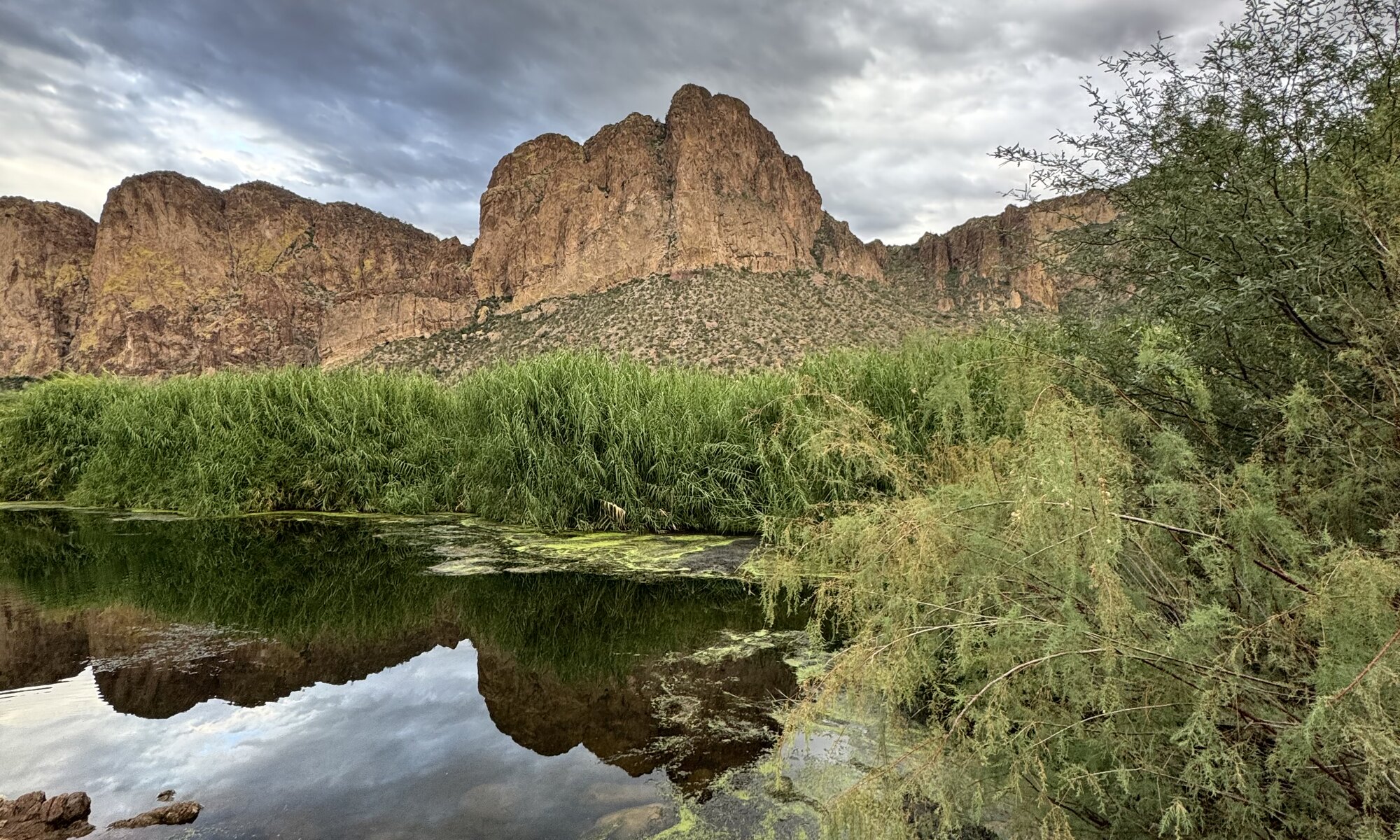
Most flood irrigation in the Greater Phoenix area is delivered by the Salt River Project, and SRP’s water does not come from the Colorado River at all. It begins as snowmelt and rainwater runoff across Arizona’s own high country, flows into the Salt and Verde Rivers, and is stored behind a chain of seven dams before it ever reaches your yard. SRP has been moving that water down this valley’s canals for more than a century.1
Now, some Colorado River water does reach central Arizona, but it travels a completely separate path via a 336-mile aqueduct called the Central Arizona Project, or CAP. CAP pumps it uphill from Lake Havasu to Phoenix and Tucson. When you read about Colorado River cuts, you are almost always reading about CAP water. Your SRP zanjero opening a gate on irrigation day is a different story and situation.
That being said, it’s important to note that although the City of Phoenix draws close to 60 percent of its municipal supply from the Salt and Verde Rivers through SRP, it does receive about 40 percent from the Colorado through CAP.2 So yes, there is Colorado River water in the Valley. It just isn’t the water flooding most irrigated backyards.
Most Phoenix flood irrigation never touches the Colorado River.
What’s going on with the Colorado River?
The nuance behind this question takes a long time to explain (and has been done many times by those closer to CAP than me—see additional resources at the end of this post). But basically, the Colorado River is currently experiencing what water experts call a “structural deficit,” meaning the river has, for a long time, been drawn against to supply more water than it reliably produces. Basically it’s at risk of an overdraft, just like a bank account with too many bills and not enough income.
After years of drought, Lake Mead and Lake Powell recently fell low enough for the federal government to declare a shortage. For 2026 the river sits in a Tier 1 shortage, and Arizona is absorbing most of the reduction—about 512,000 acre-feet, almost entirely through CAP.3
Who feels those cuts? Well, CAP water follows a priority system, so the first and deepest reductions fall on agriculture, particularly the farms of Pinal County, rather than on cities (or on SRP irrigation customers).4 The current operating rules expire at the end of 2026, and Arizona, California, and Nevada are now negotiating what replaces them. (Spoiler: talks aren’t really going well.)
Yes: this is serious. But—in the words of ASU’s Kyl Center for Water Policy5—it is also manageable. Arizona has known this reckoning was coming for decades and spent that time banking water underground and building backups. In fact, some say that Arizona is one of the best-positioned states to handle this crisis because we’ve been adapting to life in the desert the longest. The City of Phoenix, for one, says a Tier 1 shortage will not affect its ability to serve customers thanks to senior rights, stored groundwater, and water it has exchanged and saved with other cities in anticipation of this situation. Serious? Yes. Manageable? Also yes. Like our therapists say: two things can be true at once.
An important nuance (among many nuances)
Please understand that not every flood irrigated property in Arizona drinks from the same cup. SRP’s snowmelt-fed Salt and Verde system that serves most of the Phoenix metropolitan area is, in SRP’s own words, nearly in balance (i.e. the water coming in and the water going out roughly match).6 That is a very different position from the Colorado’s structural deficit. Is this something to brag about? No. Does it offer me significant reassurance as an SRP customer? For sure.
I would be remiss, of course, if I didn’t note that some parts of the Valley do receive Colorado River water through CAP. For those lots, the river’s troubles are a more direct concern than they are for a snowmelt-fed yard in Arcadia or Mesa. I always recommend my buyers research the source of their flood irrigation water if flood irrigation access is important to them.
(And yes, I’ve seen the viral video of the farmer near Coolidge whose water was cut off by her district. That is a different district and separate system than SRP and even CAP—it’s the San Carlos Irrigation Project,7 which sources its water from multiple sources including the Gila River, groundwater/wells, reservoirs, and CAP. Again, it’s a serious problem; again, it’s different than most irrigation districts in the greater Phoenix Metro area. Like I’m always saying, there is so much nuance to this issue. I am mindful of the water security issues facing communities in the Southwest and throughout the world and, for what it’s worth, I’m committed to doing all I can to help.)
What does it all mean for Arizona homeowners with flood irrigation?
If your flood irrigation comes from SRP, you are holding one of the most senior and secure water rights in the state, on a system that does not lean on the Colorado at all. The number to watch is not Lake Mead. It is the winter snowpack on Arizona’s mountains, because a dry winter means a lighter runoff into the Salt and the Verde.
I will never tell you any desert water source is immune to a warming climate, because none of them are. But invincibility and resilience are not the same, and it does no one any good to confuse them in either direction. Panic is not a plan. Neither is pretending there is no need to conserve. (In another post I’ll talk about what I will personally do if I ever lose access to flood irrigation—I’m a mother; of course I’ve considered this.)
But for now, I’ll leave you with my biggest takeaway (and how I sleep at night) as Arizona’s flood irrigation real estate specialist:
After countless hours of research, interviews, classes, and water facility tours, I firmly believe that the best thing any flood irrigation homeowner in Arizona can do with their water is to put it toward its highest and best use: growing food and feeding our communities.
Because at the end of the day, when Arizonans use flood irrigation to grow fruit, they’re also shading their yards, reducing their dependence on power-hungry HVAC, cooling their outdoor spaces, recharging their groundwater stores, and beautifying their neighborhoods.
And that does not sound like a waste to me at all. 
Sources & additional resources
- SRP — Where your water comes from ↩
- City of Phoenix — Drought & water supply ↩
- Central Arizona Project — Colorado River shortage ↩
- ASU Arizona Water Blueprint — Colorado River drought & shortage ↩
- ASU Kyl Center for Water Policy ↩
- SRP — Managing water and drought ↩
- San Carlos Irrigation Project — water sources ↩

Camille Fairbanks, eXp Realty and native Arizonan, is a GREEN Certified REALTOR® and flood irrigation specialist. She is delighted to serve home buyers and sellers in Mesa, Tempe, Scottsdale, Phoenix, Chandler, Gilbert, Queen Creek, San Tan Valley, and beyond. She helps Arizonans understand the true value of flood irrigation, water rights, and mature fruit trees. Aside from real estate, Camille is passionate about sustainable housing, regenerative farming, urban gardening, food forests, and carne asada burritos.