Home / Neighborhoods / Greater Green Gables
Named for a sandstone castle on the Grand Canal, this central-east Phoenix neighborhood hides something most buyers assume they can't afford: flood irrigated lots — at some of the most accessible prices in the Valley.
From 1939 to 1984, the corner of 24th Street and Thomas Road held a sandstone castle: the Green Gables restaurant, one of the first medieval-themed restaurants in America. There were knights on horseback, a Robin Hood parking attendant, and a guest list that ran from Clark Gable and Bob Hope to a young Waylon Jennings, who bussed tables there before he was famous.
The restaurant's original 11-acre site was a triangle bounded by Thomas Road, 24th Street, and the Grand Canal — and it's that third edge, the canal, that matters most to this story. The Grand Canal is the thread that ties the neighborhood's name to its water, the reason there's flood irrigation here at all.
The castle is gone, but the name stuck, and so did the canal. The Greater Green Gables Neighborhood Association formed in 2005 to look after the area that grew up around it — roughly 4,200 residents in a grid of mostly 1940s and 1950s homes.
Community photos of Greater Green Gables go here. None featured yet — submit one (no people, please) and you could be the first.
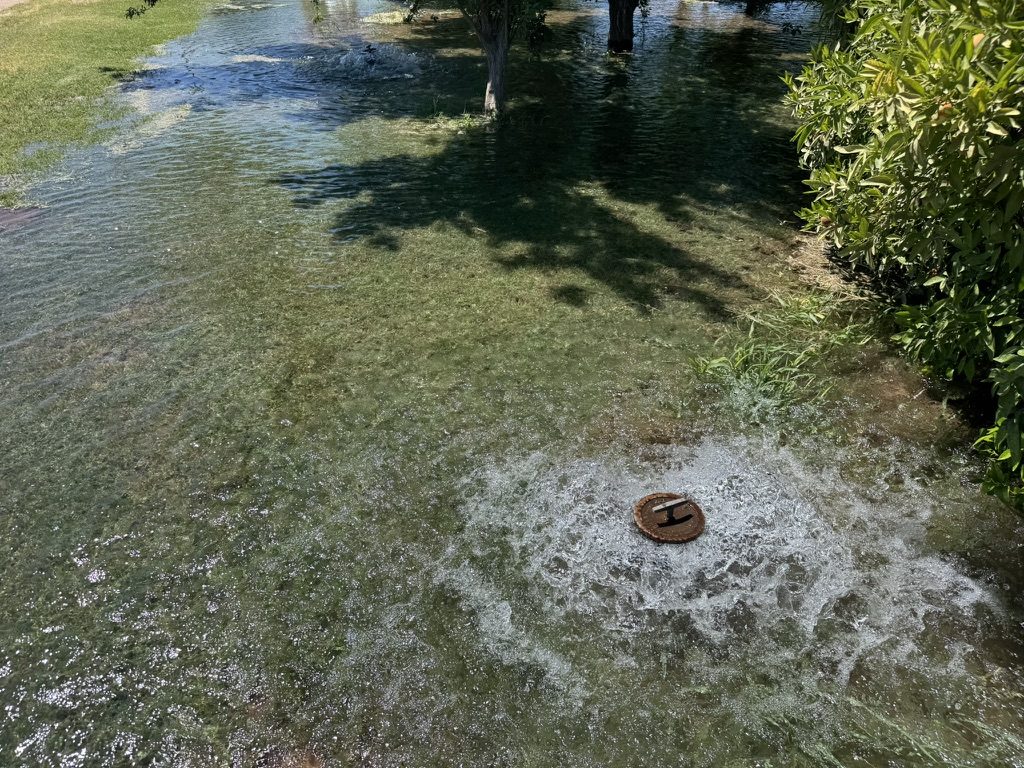
Submit a PhotoSRP flood irrigation is present in Greater Green Gables — a 2026 sale on North 26th Street advertised a quarter-acre lot with SRP irrigation. But here the water is genuinely under-documented. The listings barely mention it, the public record is thin, and that is precisely what makes it a hidden gem: irrigated lots that most buyers, and most agents, never realize are there.
That also means the usual caution matters even more here than elsewhere. Irrigation in this neighborhood is the exception, not the rule — most lots do not have it. So a lot that flows is a find, and confirming the water on a specific property, through the account and the infrastructure, is essential before you write an offer. This is a place where knowing how to read a parcel instead of an MLS field pays off.
What to Verify About Water Rights
Central-east Phoenix (zips 85006 and 85008), bounded by Thomas Road, McDowell Road, the SR-51 freeway, and 26th Place — with the Grand Canal cutting through near the old castle site.
Schematic, not to scale. Boundaries are informal and the canal and castle site are approximate; irrigation status varies lot by lot and must be verified for any specific property.
Most people assume an irrigated lot in Phoenix means an Arcadia price tag. Greater Green Gables is the exception that proves it doesn't have to.
In the last year, 32 of 34 single-family sales closed under $600,000. For buyers who assumed a flood irrigated lot was out of reach, this is one of the few corners of the Valley where the math works.
The housing stock is largely from the 1940s and 1950s — the median home was built in 1950, with some dating back as far as 1915. Solid, older homes on in-town lots, close to central Phoenix.
If you've wanted room to grow — citrus, a garden, a small food forest — without a luxury-neighborhood budget, this is a place to look. The catch, and the opportunity, is that you have to find the lots that still have water.
A look at the last twelve months of closed single-family sales inside the boundaries — what's selling, for how much, and how often flood irrigation shows up in the data.
Single-family homes sold in the past 12 months, with a median of 89 days on market.
Sales ranged from $133K to $882K — and 32 of the 34 closed under $600K. Median of $268 per square foot.
Median home size and year built — mid-century houses on in-town lots.
Median lot size, with the irrigated sales skewing toward the larger lots.
Only 7 of the 34 sales were marked flood irrigated in the MLS — and at least 1 more advertised SRP irrigation in the listing text without ever being flagged in the field. With a pool this small, we won't publish a price comparison here — it would be irresponsible to draw conclusions from a handful of homes. The point is simpler: the MLS alone misses irrigated homes, and in this neighborhood it misses most of them.
Source: ARMLS closed-sale data, single-family homes, SR-51–26th Pl / Thomas–McDowell, Nov 2025–Oct 2026. Information deemed reliable but not guaranteed. Medians shown; individual results vary.
Greater Green Gables doesn't announce itself. It's in-town, close to the Grand Canal path and minutes from central Phoenix, with an active neighborhood association and a block watch — a quiet, older, unpretentious grid of a neighborhood. That modesty is exactly why the irrigated lots here have stayed a secret.
For the right buyer, that's the whole appeal: a flood irrigated lot at an in-reach price, in a neighborhood still being discovered. But because the water is rare and rarely advertised, this is a place where a specialist earns their keep — separating the lots that actually have active, transferable irrigation from the ones that don't.
If you're hunting for an affordable irrigated lot, read the parcel, not the price. And if you own one here, you may be sitting on more than the listing comps suggest — the water is part of the value, and it deserves to be told.
What flood irrigation actually costs → · What is flood irrigation? →
Historic and neighborhood details on this page are drawn from public records and local history, including accounts of the former Green Gables restaurant. This page is an independent neighborhood guide; it is not affiliated with or endorsed by the City of Phoenix, SRP, or any neighborhood association. Neighborhood boundaries are informal, and property-specific irrigation status should always be verified individually.