Home / Neighborhoods / Fraser Fields
Where Mesa first learned what a custom ranch home could be — and where the water still arrives the old way, flooding the lawns green under trees that have been drinking deep since Truman was president.
That’s what Hyrum Smith Phelps paid for this plot of land in the early 1900s — eighty dollars and a horse. He built an adobe house on it for his wife, Sara Lucretia Pomeroy, and farmed the ground the way everyone in early Mesa did: with water flooding across it from the canals the Hohokam had traced across this valley centuries before anyone thought to call it Mesa.
Phelps sold to Dr. Jack Fraser, who built his own home on what was then Fourth Street — University Drive today. And in 1946, Fraser sold to the Passey Investment Corporation, which platted an 80-acre subdivision and gave it the name it still carries: Fraser Fields.
Starting in 1947, the Mesa Journal Tribune advertised it as “Mesa’s Most Exclusive Subdivision.” The lots were nearly double the size of an average city lot, with at least 100 feet of street frontage, paved streets, city water and gas — and underground irrigation, listed right there in the ads as a modern amenity. Lots sold for $800 to $2,000, and the ads carried three-digit phone numbers.
This was the first major subdivision in Mesa built for families moving outward from the town center — the leading edge of a story that would play out across the postwar American West. Fraser Fields is where that story starts, in Mesa, and where it has been best preserved.
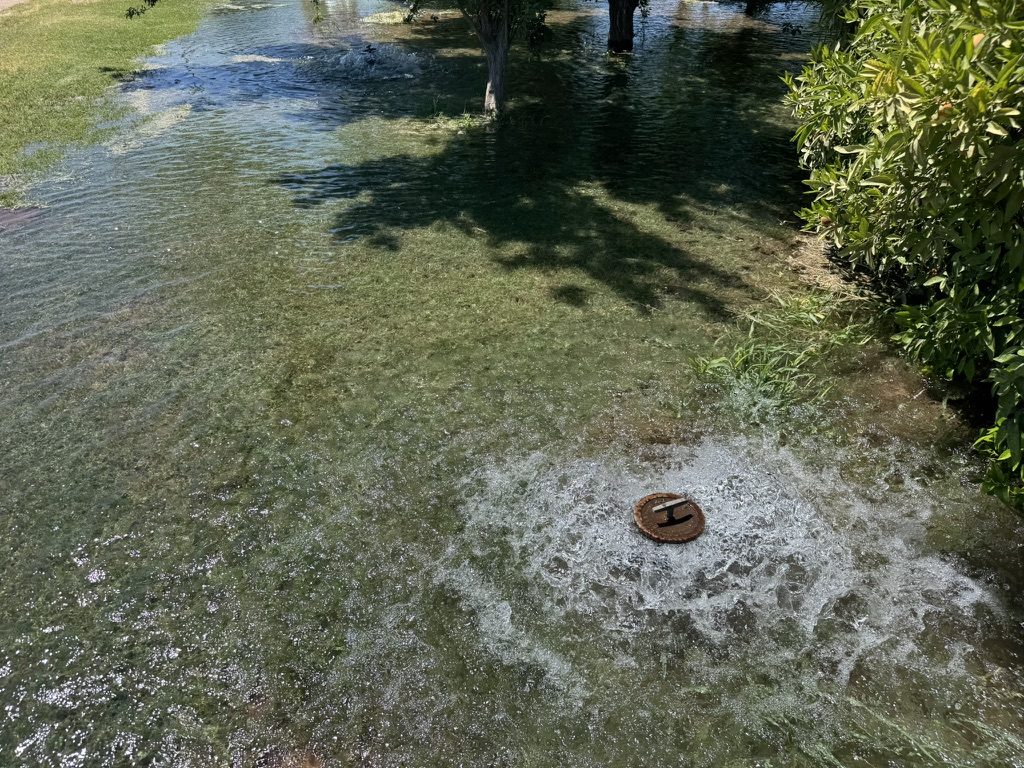
Walk Fraser Fields in July and you’ll notice something that doesn’t quite add up for the Sonoran Desert: deep lawns, towering shade trees, the kind of green that usually costs a fortune in sprinkler water. It doesn’t. It’s flood irrigation — the same system that was a selling point in those 1947 newspaper ads, still working.
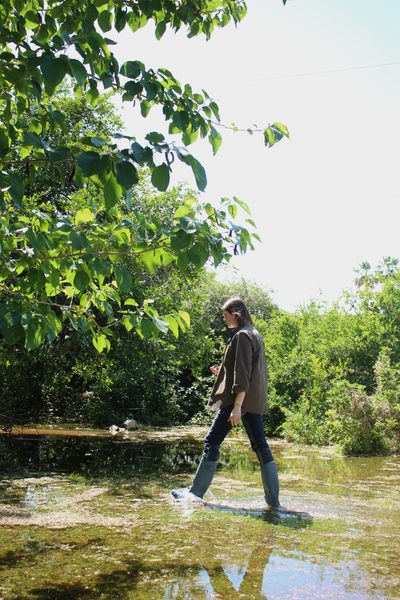
Water is delivered through the Salt River Project system, drawing on some of the most senior water rights in Arizona. On delivery day, a zanjero opens the gate, the water moves through the neighborhood’s ditches and pipes, and yards fill like shallow, temporary lakes. A few hours later the water has sunk deep into the soil — down where roots grow strong, where trees survive August without stress, where a lawn stays green on pennies per day.
One honest caution: not every lot in the neighborhood has an active irrigation account today. Water rights in Fraser Fields are appurtenant to the land, but the account status, the delivery infrastructure, and the condition of berms and valves vary from property to property. That’s exactly the kind of thing I verify before my clients write an offer — never after.
How Flood Irrigation Works
No single builder shaped Fraser Fields — and it shows, in the best way. Between 1946 and 1962, families bought their favorite lots and built to their own taste, which is why the neighborhood reads like a field guide to the American Ranch home.
Early Ranch, Classic Ranch, California Ranch, and Spanish Colonial Ranch — plus a few Contemporary houses with flat roofs and walls of glass. The “rambling” ranch houses are the showpieces, with elongated floor plans and wings angling off the main façade.
Steel casement windows with diamond or square panes. Board-and-batten siding, exposed rafter tails, shake roofs. Painted block and fired adobe. These are the character-defining details that historic designation protects — and that you simply can’t buy new.
Uniform setbacks, broad green front yards, and a loop street layout that keeps traffic slow and the feel secluded. Most homes still have their original carports and garages — kept and cared for rather than converted, which is rarer than you’d think.
Fraser Fields is still home to some of its original families. That tells you most of what you need to know. Houses here change hands slowly, often quietly, and the people who buy them tend to understand what they’re getting: nearly an acre of deep-watered soil in some cases, room for an orchard or a garden that actually produces, and a house with the kind of craftsmanship that was normal in 1950 and is remarkable now.
It’s also central Mesa — minutes from downtown Mesa’s main street, the Mesa Arts Center, and the light rail, in a neighborhood that feels a world apart from all of it.
If you’re looking for a flood irrigated property with history in its bones, Fraser Fields belongs at the top of your list. And if you own here and are thinking about selling, the story of your property — the water, the trees, the architecture — deserves to be told properly to the buyers who will value it most.
Historic details on this page are drawn from the City of Mesa Historic Preservation Office’s Fraser Fields Historic District records. This page is an independent neighborhood guide; it is not affiliated with or endorsed by the City of Mesa, SRP, or any neighborhood association. Property-specific irrigation and historic-designation status should always be verified individually.